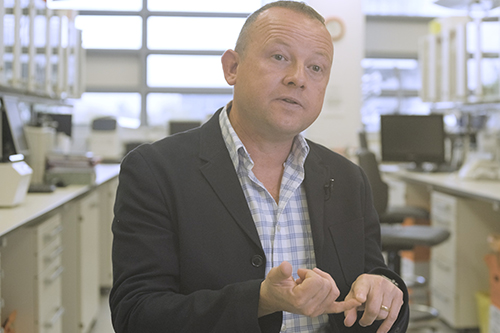
professor profile picture

Ash Toye

Professor at University of Bristol

University of Bristol

Country flag

United Kingdom

Has open position

This profile is automatically generated from trusted academic sources.

Google Scholar

.

ORCID

.

LinkedIn

Social connections

How do I reach out?

Sign in for free to see their profile details and contact information.

Meet Kite AI

Contact this professor

LinkedIn
ORCID
Google Scholar

Research Interests

Cell Biology

20%

Microscopy

30%

Biophysics

30%

Biology

30%

Biomedical Engineering

30%

Red Blood Cell

30%

Ask ApplyKite AI

Start chatting
How can you help me contact this professor?
What are this professor's research interests?
How should I write an email to this professor?

Positions3

Publisher
source

Ash Toye

University Name
.

University of Bristol

PhD in Red Blood Cell Mechanosensation and Membrane Tension Modulation (Cell Biology, Biophysics, Bioengineering)

A fully funded PhD opportunity is available to investigate the mechanisms of mechanosensation and membrane tension modulation in red blood cell development. The project is jointly hosted by the University of Bristol and the University of the West of England (UWE), offering a unique chance to work at the interface of cell biology, biophysics, and bioengineering. The research will explore how developing red blood cells sense and respond to mechanical stress, utilizing advanced techniques such as CRISPR-based gene editing, fluorescent reporters, and live-cell imaging (including FLIM and microcapillary systems). The student will be co-supervised by Tim Satchwell (UWE), Prof Ash Toye (Bristol), Prof Tony Killard (UWE), and Prof Jan Frayne (Bristol), and will graduate with a joint degree from both universities. The project is ideal for candidates passionate about understanding cellular adaptation to mechanical environments and eager to develop expertise in erythropoiesis, mechanotransduction, and microscopy. Funding is provided by the BBSRC SWBio DTP, which typically covers tuition and a stipend. Applicants should have a background in cell biology, biophysics, or bioengineering, and experience with relevant laboratory techniques is advantageous. For more information or to apply, follow the provided link or contact the supervisors directly.

Publisher
source

Alexis Darras

University Name
.

University of Bristol

PhD Studentship in Shape and Rigidity Profiling via Density-Induced Banding of Red Blood Cells (SHARP-ID)

[Fully funded for UK Home Students, with a very small number of fully funded places available for outstanding international candidates.] PhD Studentship: SHARP-ID – Shape and Rigidity Profiling via Density-Induced Banding of Red Blood Cells at the University of Bristol . This PhD project investigates how red blood cells (RBCs) form band patterns in continuous density gradients and how these patterns can be used to detect pathological mechanical changes. The research builds on recent findings that banding arises from a balance between buoyancy and aggregation forces. The main aim is to optimize detection of RBCs with altered shape and rigidity by designing non-linear density gradients that combine the reproducibility of stable gradients with the sensitivity of linear ones. The project is highly interdisciplinary and will involve programmable syringe pumps to generate custom density gradients from two density solutions, experiments on RBCs with controlled shape and rigidity variations, and quantitative analysis using confocal microscopy and atomic force microscopy. Band patterns will be studied with automated image processing and AI-based classification trained on both simulated and experimental data. The expected outcome is a scalable, low-cost diagnostic approach with potential applications in sickle cell anemia, malaria, treatment monitoring, and early disease detection. The project sits within the vibrant research environment of the School of Physics and the EngBioCDT programme at Bristol. It draws on expertise from Professor Ash Toye and Dr Jan Frayne in red blood cell biology, clinical insight from Dr Claire Rice and Dr Sanne Lugthart in inherited blood disorders, and theoretical support from Francesco Turci and Simon Hanna. Students will also benefit from access to the Isambard-AI supercomputer and the wider collaborative, supportive research culture at the University of Bristol. Funding: This is a fully funded PhD studentship for UK Home Students, with a very small number of fully funded places available for outstanding international candidates. Eligibility: Applicants should normally hold a first degree in physics or a closely related subject at least equivalent to a UK upper second-class honours degree, or a relevant postgraduate master's qualification. International applicants must meet English Language Profile F. How to apply: Prepare a CV, a personal statement, and transcripts of any qualifying degrees. Apply through the University of Bristol postgraduate application system and select Physics PhD on the programme choice page. Shortlisted candidates will be interviewed. Deadline: 12 August 2026.

New Today